The
human example has always been a source of motivation for others. Their
problems, struggles, joys, and excitement need to be shared.
The progress of every trade by mere empirical experience, and also that of agriculture, has a limit. Every experimental method comes to an end when the senses are no longer sufficient for the perception of facts; when no new circumstance is presented to the senses for perception; when, in short, everything has been tried, and the facts resulting from such trials have been adopted into the particular art of trade. Further progress can then only be looked for, if hidden facts are sought out, the senses are sharpened for their perception, and the means of investigation are improved. But such a course is not possible without reflection, without the mind also taking its share in the operation.
Liebig (1859)
1970 Nobel Peace Prize "In recent years the 'human rights' issue has generated much interest and debate around the world. It is a utopian issue and a noble goal to work toward. Nevertheless, in the real world, the attainment of human rights in the fullest sense can not be achieved so long as hundreds of millions of poverty stricken people lack the basic necessities for life. The right to dissent does not mean much to a person with an empty stomach, a shirtless back, a roofless dwelling, the frustrations and fear of unemployment and poverty, the lack of education and opportunity, and the pain, misery and loneliness of sickness without medical care. It is my belief that all who are born into the world have the moral right to the basic ingredients for a decent, human life."
March 25, 1914 -
September 12, 2009
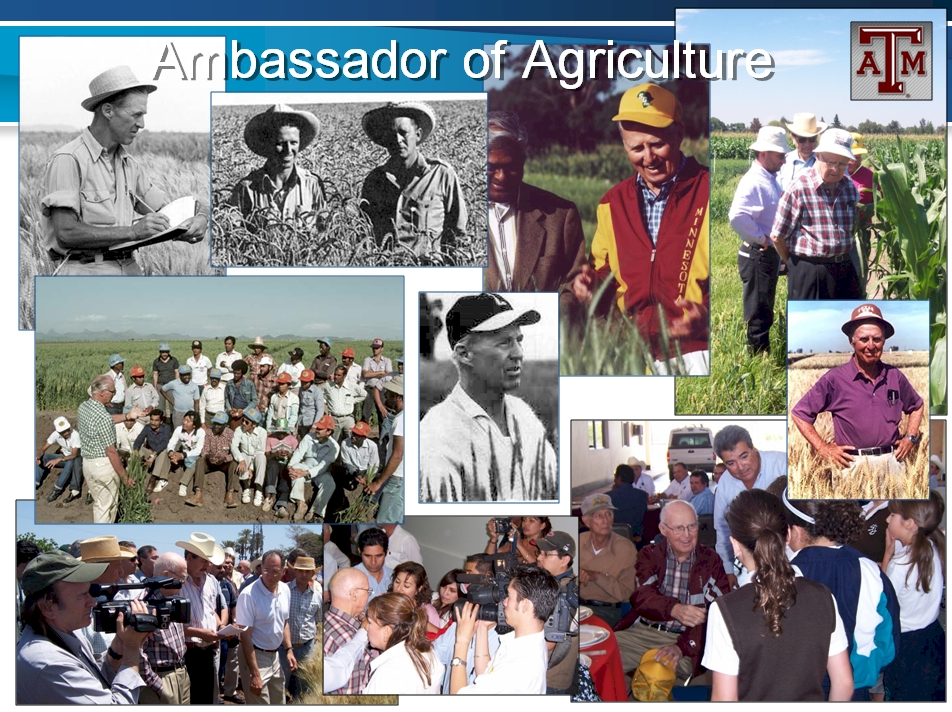
sites of Dr. Norman Borlaug
Article, Dr. Borlaug (BAE)
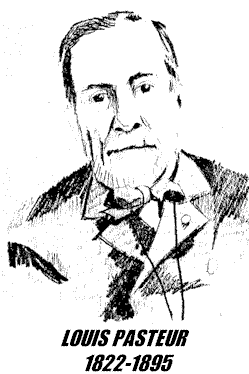
Louis
Pasteur was born in Dole, in the Province of Dura, France, in 1822. As a
chemist, and later as a bacteriologist, Pasteur did more than any other man of
his time to further medical progress. However, because he was not a physician,
many medical men of the 1800's jeered at his theories. He ignored their scorn
because he believed so strongly that bacteria, or germs, did indeed exist and
that they could cause disease. He continued to work in his own way, having faith
in himself, and eventually discovered the cure for a silkworm disease, for
anthrax and for rabies.
Pasteur
also invented a process to keep milk from spoiling. It consisted of heating the
milk to 140F for thirty minutes, then cooling it quickly and keeping it in
sealed, sterile containers. This process is still used today to keep milk free
from germs. It is called pasteurization. Pasteur married Marie Laurent of
Strasberg, whom he loved deeply. She encouraged him always to put his laboratory
first, and so he was able to concentrate on his work and do it well.
When
little Joseph Meister was bitten fourteen times by a rabid dog and was brought
to Louis Pasteur, the scientist hesitated to give his untried rabies vaccine to
the boy. He did so only after two physicians pointed out that the boy would
surely die without the vaccine, and that Pasteur just might have the answer.
Pasteur
did have the answer, of course, and he saved Joseph Meister's life. Meister
later became a gatekeeper at the Pasteur Institute. He stayed there, loyal to
Louis Pasteur, for the rest of his life. While Pasteur certainly believed in
himself, he remained a quiet and humble man until his death in 1895. In his
later years he was always a little amazed and amused by the fuss that people
made over him. Once he accepted an invitation to attend an international medical
meeting in London. When he arrived a steward asked him to come to the front of
the assembly hall. Pasteur walked forward and the members rose to their feet and
applauded. Pasteur seemed somewhat disappointed. "The Prince of Wales must
be arriving," he said. "I wish we had arrived earlier so that we might
gain a better view of him." But the chairman of the group only held out his
hand to Pasteur. "No," he said. "it is you. It is you they are
cheering."
Steven
Chu
1997
Nobel Prize, Physics
"Learning science and thinking about science or
reading a paper is not about learning what a person did.
You have to do that, but to really absorb it, you have to turn it around
and cast it in a form as if you invented it yourself.
You have to look and be able to see things that other people looked at
and didn't see before. How do you
do that? There's two ways. Either you make a new instrument, and it gives you better
eyes, like Galileo's telescope. And
that's a great way to do it, make such a nice instrument that you don't have to
be so smart, you just look and there it is.
Or you try to internalize it in such a way that it really becomes
intuitive. Working on the right
problem is only part of what it takes to succeed.
Perseverance is another essential ingredient."
AUTOBIOGRAPHY
intuition: immediate apprehension or cognition; without evident rational thought and inference; quick and ready insight